The Concepts of Ma’na and Maghza in The Thought of Nasr Hamid Abu Zayd
Keywords:
Ma'na wa Maghza, Nasr Hamid Abu Zayd, Qur’anic Hermeneutics, Contemporary Exegesis, Textual SignificanceAbstract
This study examines the concepts of ma'na and maghza in the thought of Nasr Hamid Abu Zayd as a contemporary hermeneutical approach to the interpretation of the Qur'an. Nasr Hamid views the Qur’an as a linguistic text (nashsh lughawi) that cannot be separated from the Arab socio-historical context at the time of revelation, hence he refers to it as a muntaj tsaqafi (cultural product). Within this framework, he introduces two fundamental concepts: ma’na, which refers to the historical-original meaning of the text as understood by its first audience, and maghza, which refers to the significance or core message that is universal and relevant to the contemporary context. This approach is a synthesis of Gadamer’s hermeneutics, which emphasizes interpretive freedom, and Ricoeur’s objective hermeneutics, which emphasizes the attainment of meaning through textual signs. The ma’na wa maghza methodology is applied through four steps: reconstruction of the historical context, linguistic analysis, identification of universal values, and re-actualization in a contemporary context. This study is a literature review (library research) using content analysis. The results indicate that the “ma’na wa maghza” approach represents a breakthrough in contemporary exegesis, capable of contextualizing the Qur’anic text within modern reality without compromising its historical authenticity.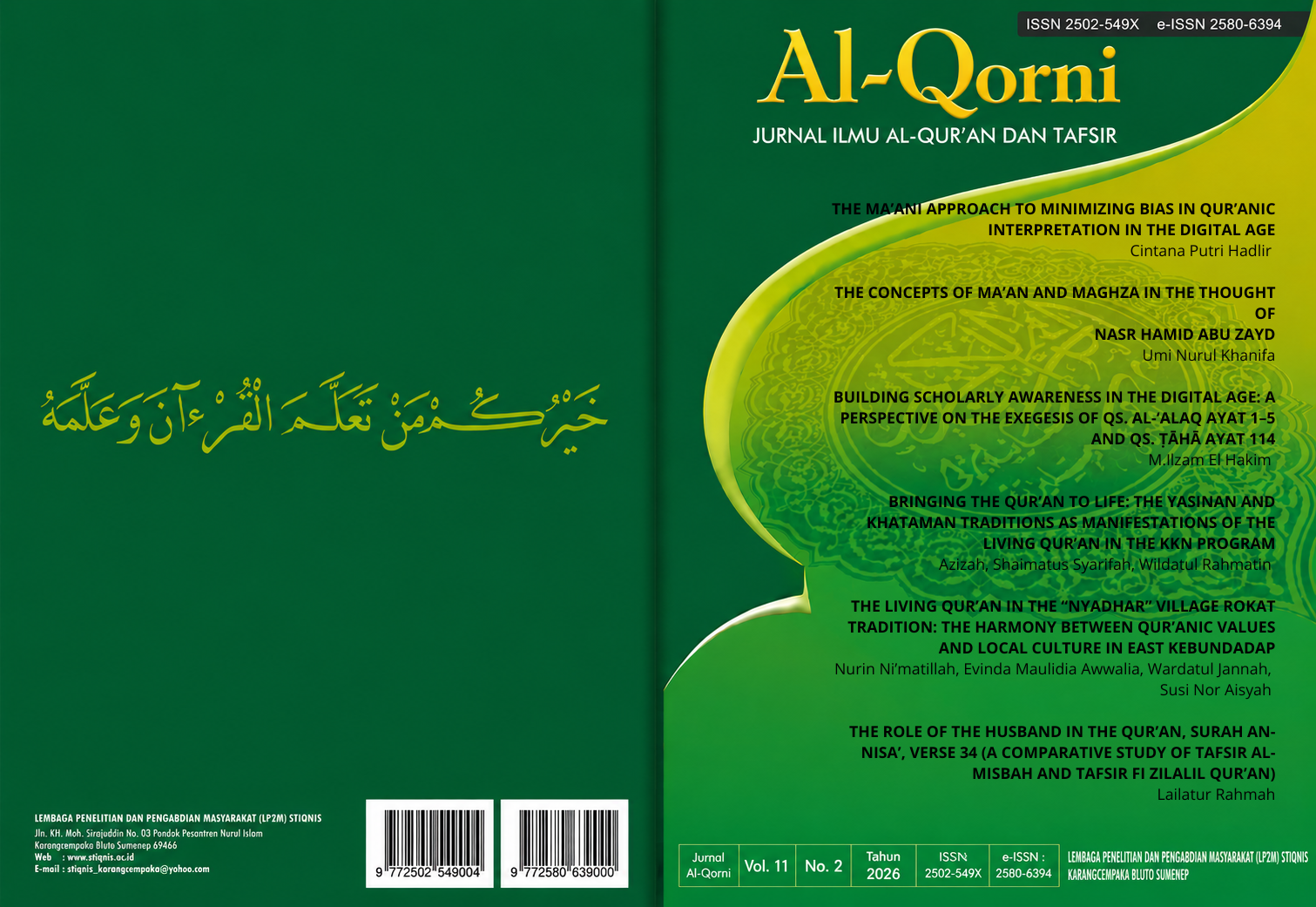
Downloads
Published
2026-08-21
Issue
Section
Articles
License
Copyright (c) 2026 JURNAL ILMU AL-QUR'AN DAN TAFSIR NURUL ISLAM SUMENEP

This work is licensed under a Creative Commons Attribution-NonCommercial-ShareAlike 4.0 International License.
AL-QORNI COPYRIGHT NOTICE
- Seluruh materi yang terdapat dalam situs ini dilindungi oleh undang-undang. Dilarang mengutip sebagian atau seluruh isi situs web ini untuk keperluan komersil tanpa persetujuan dewan penyunting jurnal ini.
- Apabila anda menemukan satu atau beberapa artikel yang terdapat dalam AL-QORNI yang melanggar atau berpotensi melanggar hak cipta yang anda miliki, silahkan laporkan kepada kami, melalui email pada Priciple Contact.
- Aspek legal formal terhadap akses setiap informasi dan artikel yang tercantum dalam situs  jurnal ini mengacu pada ketentuan lisensi Creative Commons Atribusi-ShareAlike (CC BY-SA).
- Semua Informasi yang terdapat di AL-QORNI bersifat akademik. AL-QORNIÂ tidak bertanggung jawab terhadap kerugian yang terjadi karana penyalah gunaan informasi dari situs ini.

