Bringing The Qur’an to Life: The Yasinan and Khataman Traditions as Manifestations of The Living Qur’an In The KKN Program
Keywords:
Living Qur'an, Completing The Qur'an, Religious Practices, Village CommunitiesAbstract
Living Qur’an studies constitute an approach to Qur’anic studies that views the sacred text not only normatively but also through the social practices of communities. This approach positions the Qur’an as a dynamic reality manifested in religious traditions, rituals, and practices. This article aims to analyze routine Yasin recitations, rotating Yasin gatherings across the hamlets, and Qur’anic completion ceremonies (khataman Al-Qur’an) as manifestations of the Living Qur’an in East Kebundadap Village, Saronggi, Sumenep, particularly within the KKN STIQNIS Karangcempaka program. This study employs a qualitative method with phenomenological and sociology of religion approaches. Data were collected through participant observation, in-depth interviews with religious leaders, community members, and KKN students, as well as activity documentation. The data were analyzed interpretively to understand the meaning of religious practices in community life. The findings indicate that routine Yasin recitations contribute to the development of religious habits and collective awareness, while rotating Yasin gatherings serve as a medium of social integration that strengthens community solidarity. Meanwhile, khataman Al-Qur’an represents the community’s interaction with the Qur’an, carrying spiritual and cultural significance. These three practices demonstrate the continuity of the Qur’anic oral tradition while strengthening the social, educational, and reflective dimensions of the Living Qur’an. The involvement of KKN students further supports the transformation and actualization of Qur’anic values in community life.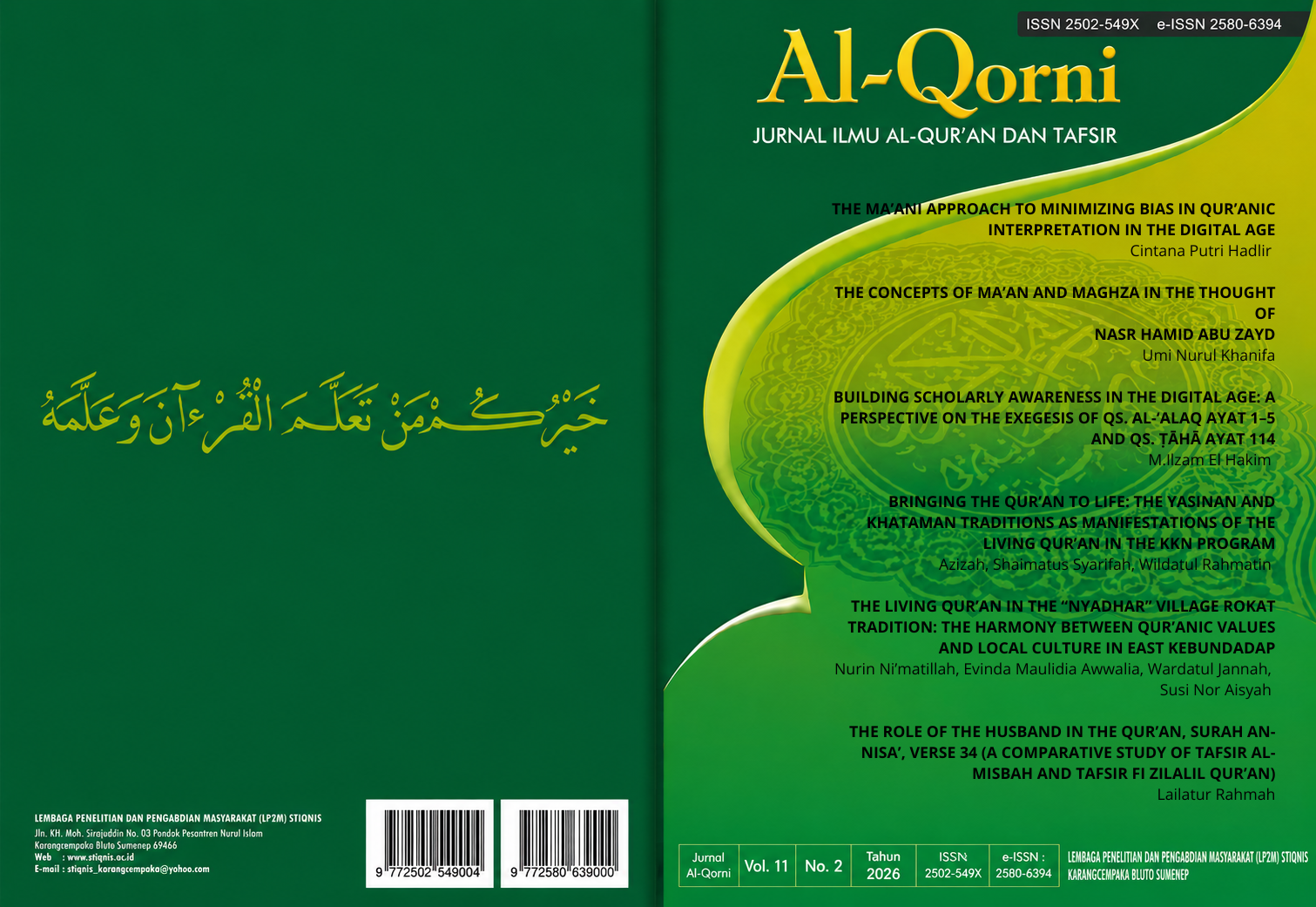
Downloads
Published
2026-08-21
Issue
Section
Articles
License
Copyright (c) 2026 JURNAL ILMU AL-QUR'AN DAN TAFSIR NURUL ISLAM SUMENEP

This work is licensed under a Creative Commons Attribution-NonCommercial-ShareAlike 4.0 International License.
AL-QORNI COPYRIGHT NOTICE
- Seluruh materi yang terdapat dalam situs ini dilindungi oleh undang-undang. Dilarang mengutip sebagian atau seluruh isi situs web ini untuk keperluan komersil tanpa persetujuan dewan penyunting jurnal ini.
- Apabila anda menemukan satu atau beberapa artikel yang terdapat dalam AL-QORNI yang melanggar atau berpotensi melanggar hak cipta yang anda miliki, silahkan laporkan kepada kami, melalui email pada Priciple Contact.
- Aspek legal formal terhadap akses setiap informasi dan artikel yang tercantum dalam situs  jurnal ini mengacu pada ketentuan lisensi Creative Commons Atribusi-ShareAlike (CC BY-SA).
- Semua Informasi yang terdapat di AL-QORNI bersifat akademik. AL-QORNIÂ tidak bertanggung jawab terhadap kerugian yang terjadi karana penyalah gunaan informasi dari situs ini.

